Stinging insect infestations in Multnomah County accelerate during the dry summer months between July and October, when colonies reach maximum densities ranging from 1,000 to over 5,000 active foragers. In historic…
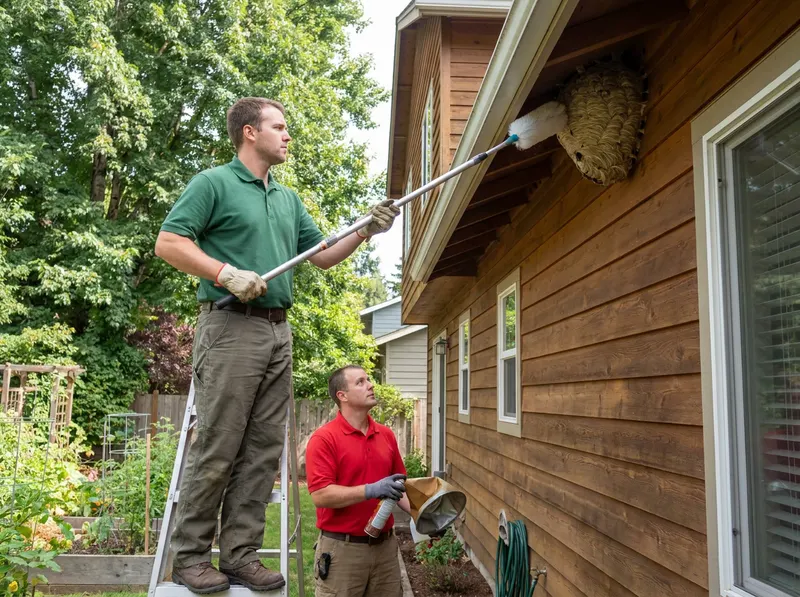
Stinging insect infestations in Multnomah County accelerate during the dry summer months between July and October, when colonies reach maximum densities ranging from 1,000 to over 5,000 active foragers. In historic architecture throughout the Alphabet District (Northwest Portland), Laurelhurst, and Eastmoreland, western yellowjackets exploit compromised tongue-and-groove soffits, cedar shingle gaps, and unscreened foundation vents. Bald-faced hornets construct large, fibrous aerial paper envelopes high in Douglas firs, bigleaf maples, or the second-story eaves of Craftsman dormers in Hawthorne and Richmond. In high-density settings like the Alberta Arts District, St. Johns, Sellwood-Moreland, and Montavilla, subterranean yellowjacket nests frequently colonize abandoned rodent burrows along rockeries and ornamental borders, presenting an immediate hazard to domestic dogs, cats, and residents.
A common misunderstanding is equating commercial broad-spectrum pesticide spraying with targeted structural nest removal. Over-the-counter hardware store aerosol sprays trigger defensive alarm pheromones (specifically isopentyl acetate in social wasps), which drives disoriented foragers deeper into interior wall voids, drywall seams, and heat vents rather than neutralizing the core nursery. The alternative, systematic Integrated Pest Management (IPM), involves pinpoint localized treatment directly into the primary nest collar, manual deconstruction and physical containment of the brood comb, and mechanical exclusion using copper mesh or silicone sealants. The trade-off is procedural access: external aerial nests on an open porch overhang take under 45 minutes to detach, whereas internal wall-void infestations require acoustic or thermal tracking through lath-and-plaster or drywall to locate the brood chamber without causing structural harm.
All field procedures prioritize domestic pet security and native pollinator protection. Non-target beneficials and native garden birds are shielded by avoiding wide-area fogging or residual flower-bed applications. If an inspection confirms a feral honeybee (Apis mellifera) colony nesting in a structural hollow, extermination protocols are halted to facilitate live extraction via regional beekeeping partnerships. Interventions operate without long-term subscription mandates, resolving the primary nesting site through mechanical exclusion and structural sanitation in one to two controlled visits.
Every job gets a firm, written price after a free on-site visit.
Tell us about your stinging insect and nest removal job in Portland and we'll send a clear, written quote, usually the same day.
 Marvexa Pest Relief